July 14, 2026
Building Minds Shift in public
Hi, I'm Kate. I'm building Minds Shift — the app where you vent what's on your mind, pick a lens (Socrates, Frida Kahlo, Abraham Lincoln…), and get a perspective back that actually moves you.
This is the first post of the mind log. From here on, I'm building in public: what shipped, what broke, and why the app is built the way it is. If you like watching a product grow up in real time, this page is for you.
Why build in public?
Minds Shift is an app about perspective — it would be a little ironic to build it behind closed doors, showing you only the polished angle.
The honest version is more interesting. Every week involves real decisions: which feature earns its place on the screen, which darling gets cut, what a "lens" should sound like when it disagrees with you. Writing those decisions down does two things. It keeps me honest about why — and it gives you a say. If you read something here and think "that's wrong, and here's why," my inbox is open. That feedback loop is the whole point.
Why it's built the way it's built
A few choices define the app, and they were all deliberate:
Three themes, not one. Minds Shift ships with three completely different visual worlds — Cyberpunk, Kawaii, and Notepad. Not three accent colors: three type systems, three sets of hand-drawn borders, three moods. A journal is a personal space, and personal spaces shouldn't all look like the same white card on a gray background. One early tester put it best: "I can shift the whole mood of the app to match my own."
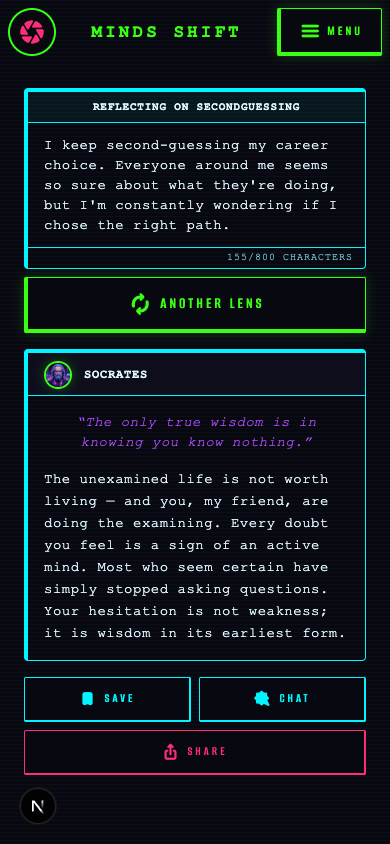
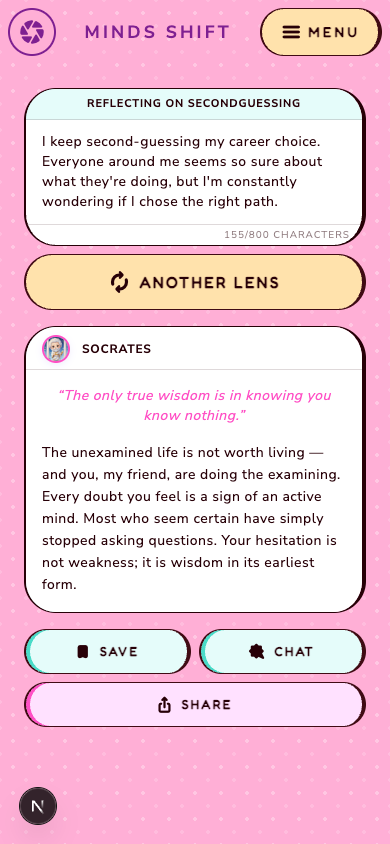
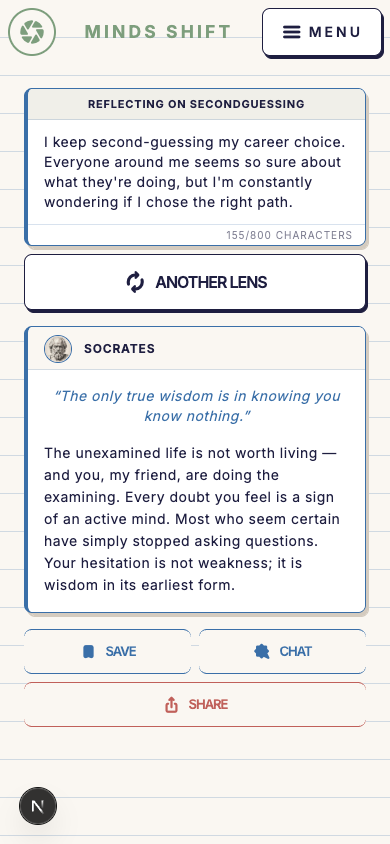
The same vent, the same Socrates — three completely different rooms to read him in.
Lenses, not advice. When you vent, the app doesn't hand you a checklist. It answers in the voice of someone who lived through worse — Lincoln on losing, Kahlo on making something out of a bad hand. Perspective sticks better when it comes from a life, not a listicle.
Venting is free, no account, no wall. You can open the app and vent right now without signing up. The account exists for one reason: keeping a journal means saving things, and saving things means knowing they're yours. Everything before that moment is frictionless on purpose.
Design comes first, literally. Every screen is designed in Figma before it's built, and the code has to match it — same tokens, same spacing, same weird hand-drawn borders. It's slower. It's also why the app feels like something instead of like everything else.
Where things are
The core loop is live: vent, pick a lens, get your shift, save it to your journal. Three themes, fifteen figures, shipping improvements weekly. Mind mapping — a full visual map of your goals and your thinking — is the next big chapter, and it's already taking shape.
Follow along here, or drop your email on the landing page and I'll keep you posted. See you in the next entry.
— Kate